| Home | Recordings | Festivals | Open Mic | Calendar | Musicians |
|---|
|
Recording Home Page Buy a CD MP3 Files Make a Recording Selling CD's |
| Home | Recordings | Festivals | Open Mic | Calendar | Musicians |
|---|
|
Recording Home Page Buy a CD MP3 Files Make a Recording Selling CD's |
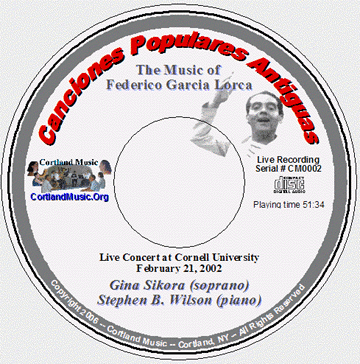
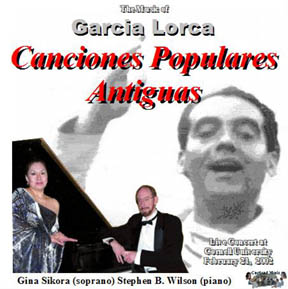
Gina Sikora (soprano) Stephen B. Wilson (piano)
|
[1-3] Introductions and History [4] Anda, Jaleo ........................................................................................ 2:43 [5] Los Cuatro Muleros............................................................................ 2:15 [6] Las Tres Hojas ................................................................................... 2:09 [8] Los Mozos de Monleon ..................................................................... 5:27 [9] Las Morillas de Jaen .......................................................................... 2:40 [10] Sevillanas del siglo XVIII ................................................................... 3:22 [12] El Cafe de Chinitas ....................................................................... 4:04 [13] Nana de Sevilla .................................................................................. 3:56 [14] Romance pascual de los Pelegrinitos ............................................ 3:46 [16] Romance de Don Boyso ..................................................................... 5:39 [17] Los Reyes de la Baraja ....................................................................... 1:23 [19] Zorongo gitano ..................................................................................... 3:36 Total playing time 51:34 |
García Lorca moved to Madrid in 1919, and made his new home in the "Residencia de estudiantes." Here he joined a generation of artists who would revolutionize Spanish culture. The painter Salvador Dalí lived there, as did filmmaker Luis Bunuel. So too did many of the young poets who would become members of the Generation of '27.
In the 1920s, Garcia Lorca published poetry, his plays were performed, he had an exhibition of his paintings in Barcelona, and compiled the Canciones Populares Antiguas or ancient popular songs that are the subject of this recording. It was a time of Garcia Lorca's greatest success.
In the 1930s, Garcia Lorca showed an increasing focus on social issues. Although he was apolitical, when asked about his political affiliations he would respond, "I am on the side of the poor."
Unfortunately, the Fascists in Spain were truly political.
In August 1936, at the beginning of the Spanish Civil War, Federico Garcia Lorca was taken to an isolated spot not far from Granada, which in Arabic is called "the spring of tears". There, he was executed by the followers of Francisco Franco. To this day, no one knows where his body rests.